
MONTEVIDEO STORY
Where the Gospel is Lived on the Margins
by Rev. Clarke Campbell-Evans, based on his trip to the Southern Cone while he worked for the General Board of Global Ministries
When I was serving with Global Ministries, my wife Sally joined me on a visit to the Southern Cone. We were traveling with Bishop Ernest Fitzgerald and his wife Frances on their Episcopal visit to the region. While we were in Montevideo, the President of the Church suggested we visit a small congregation in a very poor community. “Pastor Mario will meet you there!”
He was waiting for us when we arrived and after greeting us, he went inside to grab his guitar. He led us down the sidewalk and when it ended, we turned uphill onto a narrow, uneven path.
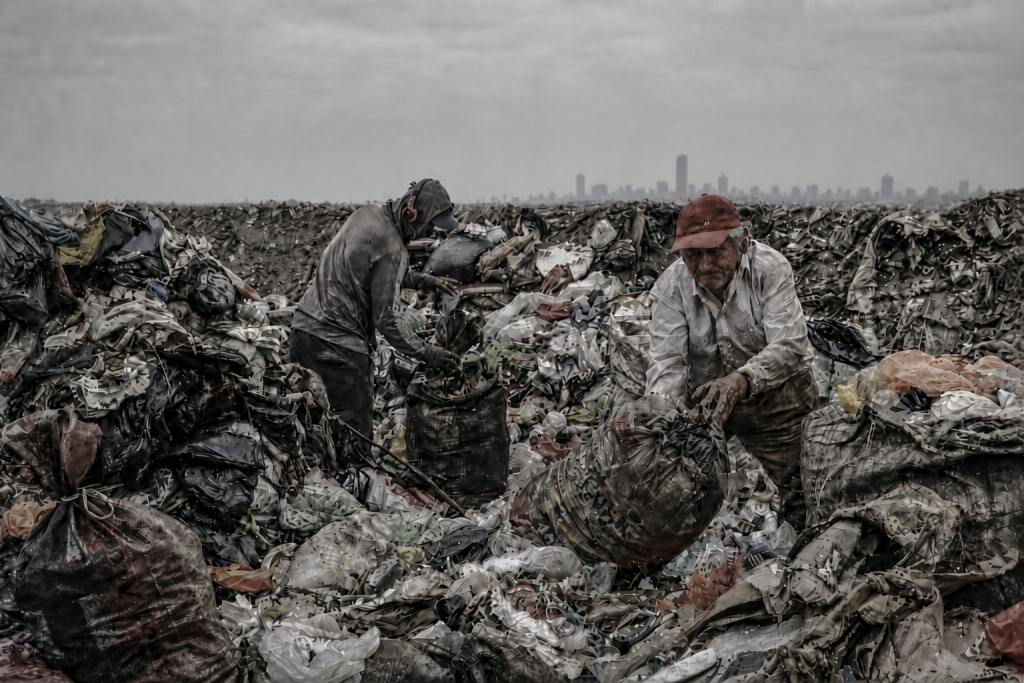

Because the path was uneven, I kept my eyes on the ground and I noticed pieces of disintegrating plastic bags peeking out from the dirt.
I looked up and saw what looked like a small cloud, thick and moving. As we got closer I saw what it was, a swarm of flies.
It dawned on me that we were not just climbing any hill, we were climbing the massive city dump of Montevideo.
When we got to the rise, we looked over and saw in the distance, on an older part of the dump, a collection of houses, maybe thirty of them, built out of cardboard and tin. Casas de cartón they are called.
In that hovel of houses, someone recognized who was coming. And all of a sudden children, with clothes barely handing on their bodies, rounded the corners of those houses, running towards us.
“Mario, Mario!” they screamed.
Two to three dozen children were running as fast as their feet would carry them. And they led us to this fire circle with rocks and logs for sitting. Mario opened up his guitar case and began to sing.
At first, the songs were playful—simple melodies that made the children laugh. Even without knowing the song, you could feel the joy. The children leaned in, fully present, fully alive in the moment.
Then, gradually, the songs began to change. The laughter softened. The rhythm slowed. And Mario began to sing about faith.
Then he sang a song I recognized:
“Red and yellow, black and white,
they are precious in his sight…
Jesus loves the little children of the world.”


In that moment, everything around us—the poverty, the harshness of that place—seemed to fade. Because what Mario was proclaiming to those children was unmistakable:
“Despite where you live, you are not garbage. You are not forgotten. You were created in the very image of God. And you are deeply loved.”
Mario was not waiting for better conditions. He was not waiting for more resources. He was already there.
Forming young disciples.
Creating community in one of the most difficult places imaginable.
Through his presence, God’s love was becoming tangible and real. Children and youth were not on the margins of this ministry—they were at its very heart. And the church, in that place, was living the Gospel in a way that transforms lives.
This is the kind of leadership Encounter with Christ seeks to support.
Not by defining the ministry—but by strengthening what local leaders like Mario are already faithfully doing.
POSTSCRIPT
Casas de Cartón by Los Guaraguao
On a subsequent visit to Uruguay, I was visiting Salto, Uruguay and staying with Methodist Pastor Diego Frisch and his family. I told him about the visit to the city dump when he ran to get an album and played me a song by the Venezuelan group, Los Guaraguao with the title Casas de Carton (Houses of Cardboard).
Words and music written by Ali Primera. 1972.